Sunlight and Bathrooms and Ceiling Tiles, Oh My!
Superintendent Sanville and the Middle School Feasibility Team claim to have done a fair and comprehensive analysis that lead them to the decision to tear down CFPMS and build a new school in its place. A review of their analysis will show they started with the desire to build a new building and spent a year working with architects to find reasons to replace CFPMS and then crafting the misleading messaging to justify it. The information below examines their claims and illogical conclusions.
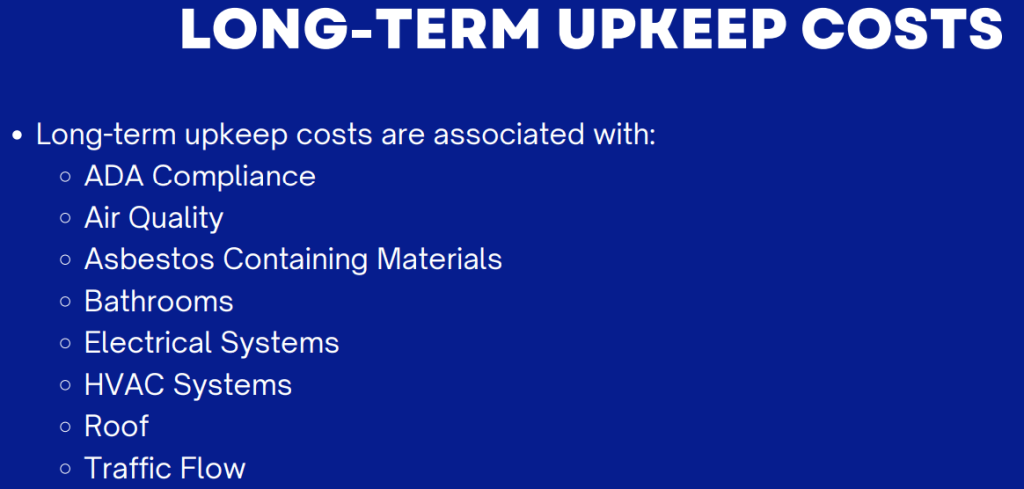
The Middle School Feasibility Team’s (MSFT) December Community Conversation summarizes the problems on slides 7, 9 & 10

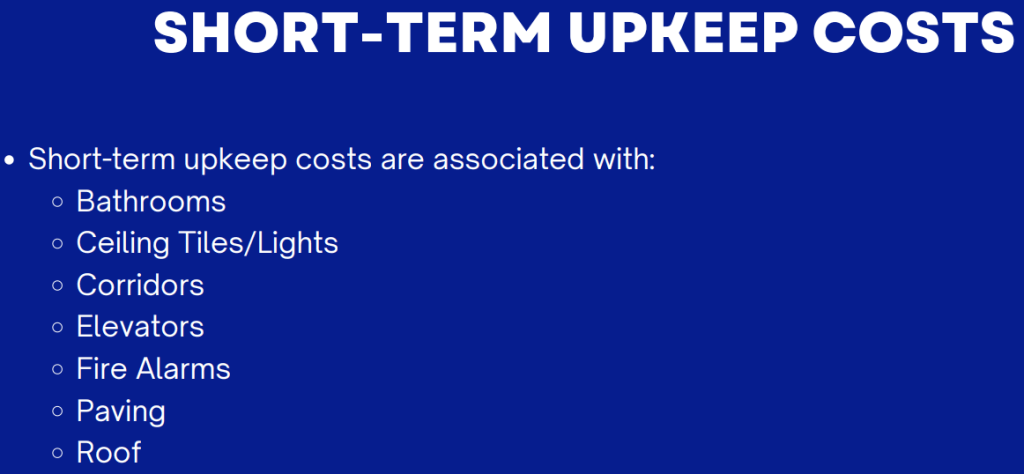
Additional details are provides on slides 25-32.
Let’s review the long-term concerns one by one.
- Lack of sunlight. Yes, this is a concern. Just about everyone prefers some natural light. That said, when students were asked if they need more sunlight, they repeatedly pointed out that the teachers are always lowering the blinds to see the smart board1. Moreover, there is now LED technology that mimics full-spectrum sunlight. This was not mentioned by the District in any of its reports or presentations. So how important is this problem today?
- ADA Compliance. According to the detailed Feasibility Study, the restrooms are not compliant (page 14); there is insufficient clearance beside doorways built before 1980 (page 44); and the ramp between the 1st and 2nd floors is no longer ADA compliant (page 46). These are concerns that should be studied and addressed. CFPMS has operated out-of-ADA-compliance for the 35 years since the ADA was passed, including a major expansion in 1997. Should we make sure that people with disabilities have safe, convenient access to CFPMS? Yes, of course. But these issues aren’t new. Why the sudden rush to replace the entire building without even looking at what would be needed to address each ADA issue?
- Air Quality. On pages 31-32, the Feasibility Study states that
“The use of a return air plenum system, insufficient insulation on the supply air distribution system ductwork, ongoing compressor failure and high indoor relative humidity conditions based on the type of system coupled with areas which are only heated and ventilated has created comfort and indoor air quality issues.”
“The existing building systems are typical 1970’s and 1980’s types which create poor indoor air quality conditions while not being energy efficient. There is a combination of equipment types ranging from heating and ventilating units, gas fired, direct expansion rooftop units, rooftop multizone units, boilers, chillers, hydronic unit ventilators and fan coil units, variable refrigerant flow systems and multiple terminal heating device and/or ventilation systems that are not wholly controlled by the building automation system.”
It sounds like there’s an opportunity to consolidate and renovate these systems. This should be handled through routine capital planning.
- Asbestos. The Feasibility Study states that there is asbestos in some of the flooring. This should be addressed, but given that the asbestos has been locked up under the floor for 40 or more years, it’s probably not urgent. And no one has claimed that it is. The regular capital plan should plan to replace these floors before they begin to degrade and pose a health risk.
- Bathrooms. Yes, they’re dated, but they’re clean and in good repair. Aside from the ADA concerns mentioned above, this is a red herring.
- Electrical System. Page 48 of the feasibility report recommends replacing the Cutler Hammer components installed in 1998 (and 800A distribution panel and some surge suppression devices). Again. Not urgent; part of the long-term plan.
- HVAC. The CFPMS HVAC units were replaced in 2016-2017 for $2.3 Million. Replacing them again is not included in the District’s latest long-term facilities plan (page 10). A question about the HVAC units was raised during the December 6, 2024 “Community Conversation #2” meeting and the District responded that these are not in the long-term plan because “we do not anticipate needing to replace them within the planning horizon.” This is another meaningless item added to increase the list of reasons to replace CFPMS.
- Roof. See HVAC above.
- Traffic Flow (cars and buses). This has been a concern and the Feasibility Study includes a detailed traffic study from 2019. Traffic flow between the middle school and high school can be addressed with or without replacing the middle school. No one has claimed any economies of scale by doing them together. Yet another fake item added to increase the list of reasons to tear down Patton Middle School.
Now let’s review the short-term concerns one by one.
- Bathrooms. See section above.
- Ceiling tiles / lights. The Feasibility Study states on page 23 that “Many of the corridor ceilings are in good condition, though there are several areas of ACT ceiling that should be repaired due to apparent water damage”. Then it shows some examples.
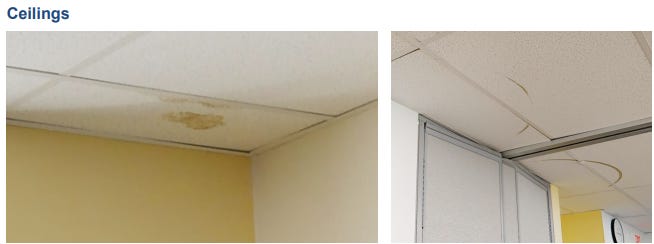
It takes some real chutzpah or just good old fashioned disrespect for your audience to include stained ceiling tiles which can be purchased at Home Depot for about $7 each as a justification to spend $120 Million (really $260 Million) to replace a building.
The Feasibility Study doesn’t mention any problem with lights, but points out that older classrooms don’t have dimmable lights, which most may agree are worth adding.
- Corridors. Page 41 of the Feasibility states:
“The hallways are very narrow and get congested between classes. The central stairwell creates a bottleneck as students circulate between floors. Due to the layers of additions, some hallways and stairwells create blind spots in supervision of students. Other areas have multiple classroom entrances too close together, preventing students from being able to easily egress between those rooms and nearby lockers to change classes.”
Yes, the hallways are crowded in between classes. So what?
Incidentally, the proposed replacement school design is a letter “E” shape whereas the current CFPMS is more of a number “8” shape. So even with wider hallways, students with a class in a different extremity of the “E” will have longer to walk, leading to more students in the hallway.
- Elevators. Some people would like a second elevator, but no one has claimed the current elevator is insufficient or problematic.
- Fire Alarms. Alarms have been updated between 1998 and 2016. There are “synchronization issues” between the older and newer parts of the system, but it’s to code.
- Paving. Is not really mentioned in the Feasibility Study. There are some potholes and they should be resolved as part of routine capital planning.
- Roof. Another duplicate item.
Other Concerns
In repeating the need for a new building, Superintendent Sanville has chosen “chronic concern” as his catch phrase. In support of that, he raised several other concerns not listed above:
- The current classrooms are not the right configuration and new rooms are needed to enable better teaching of STEM, etc. When asked, he didn’t explain or provide data as to how new classroom configurations would improve STEM educational outcomes.
- The gymnasium is not large enough to fit the entire student body.
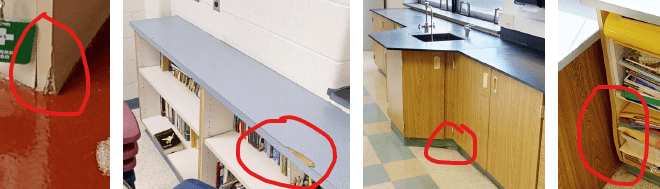
- There’s a lot of wear and tear. Examples of scuffed corners, chipped linoleum counters and torn wall pads in the gymnasium can be found on pages 24-25 of the Feasibility Report.
- He has also repeated the point that even if we opt for the $68 Million “Maintain” plan for the middle school, which addresses all of these items except the hallway size and sunlight, these problems still won’t be solved. But he hasn’t elaborated on what problems would still remain.
- When surveyed, the faculty responded that they’d like thermostat control, more whiteboards, larger classrooms and more storage space.
- Of major importance, the District expects school enrollment to remain flat over the foreseeable future. The proposed new middle school would offer the same amount of classroom space but be slightly large due to a larger gym, cafeteria, etc. And the enrollment projections ignore the major risk of the advent of school choice, which could have a major impact on UCFSD, particularly as the District’s student performance declines.
Does CFPMS Need to Be Torn Down and Built Anew?
Most of the items listed as problems are routine maintenance (either wear and tear like paint and ceiling tiles) or planned capital expenditures (like replacing the roof and HVAC). There are a few unplanned expenses like ADA compliance that should be incorporated into the capital plan and addressed. But none of them are urgent. And the district has been making capital improvements responsibly over the years. The UCFSD website stated that CFPMS is “in excellent condition” and is “solid and secure” (until the District took down this statements, presumably because they did not comport with the Administration’s desire to build a new school).
Is CFPMS going to win any architectural awards? No. Are there a lot of windowless interior classrooms and hallways? Yes. But it’s on par with many large buildings, and if your goal is to add sunlight, skylights and bulbs that emit the sun’s spectrum are much cheaper options. The structure is in good condition and the $68 million budgeted in the “Maintain” option would go a long way. And, save each taxpayer $27,500 over 35 years.
Ultimately, we all want to make the best use of school district resources to deliver the best education and experience to our students which includes providing a pleasant working environment for teachers and staff. Is replacing a B+ building with a sunny, A grade building2 the best way to do that? Or should solving other problems be the priority (catching up from Covid, adopting a modern, phonics-based reading program, supporting advanced students to get into good colleges, etc.)?
Superintendent Sanville and the Middle School Feasibility Team have been arguing very hard that throwing out the existing building to make way for a new one is the right approach. To justify replacing CPFMS they have deceptively underestimated the cost of a new building and inflated the cost of the “Maintain” option (which addresses all of the concerns listed above except for sunlight). Moreover, they will not consider other options that do not address every problem on their wish list, or would address them over a longer timeframe.
The School Board thinks that our community overwhelmingly supports spending $120 Million ($260 Million with financing) to replace old bricks with new bricks3.
What do you think? Share your opinion with the School Board by emailing ucfboard@ucfsd.net.
Links:
What’s the real cost per taxpayer of Replacing the Charles F Patton Middle School?
Did the Feasibility Group inflate the Maintain option to make Replacement look more attractive?
Footnotes
1 If you finished school before year 2000, a smartboard is the new version of this.
2 Fun fact. The district’s hypothetical Replacement middle school buries the Art, Tech Ed, Computer Ed, and FCS (Home Economics) classrooms in the interior, where they won’t have access to windows (unless they install skylights, which no one has bothered to propose for the existing middle school). See slide 40 of the Feasibility Study Summary.
3 Board Member Anderson thinks fewer than 5% of residents oppose replacing the middle school. Watch the February School Board Meeting at 2:34:10.
 Why the Rush to Replace Patton Middle School?
Leave a Reply